Showing posts with label apple. Show all posts

Thursday, February 13, 2014

How you sign your work in Silicon Valley: About Boxes, Easter eggs, and computer cases

Sometimes in Silicon Valley we make stuff. Like any makers, or really anyone who wants a bit of fame and immortality, we like to sign our stuff. There are many ways to do this.

Even in ancient, pre-Mac times, software usually had credits buried in it somewhere. With the advent of graphical user interfaces in the mid-1980s, the About Box became the standard place for credits. The About Box was easily accessible to users and was always found in the same place. This box was in the original Finder and was one of the first About Boxes many Mac users ever saw:


Through the 1980s, most companies were OK with this practice. Apple was schizophrenic, keeping some teams from announcing themselves while encouraging others to sign their work. The original Mac team literally signed the case mold, ensuring their names would appear on the inside of every Mac produced.


As technology progressed, About Boxes got fancier. One version of MultiFinder for Mac got out the door with this epic About Box:

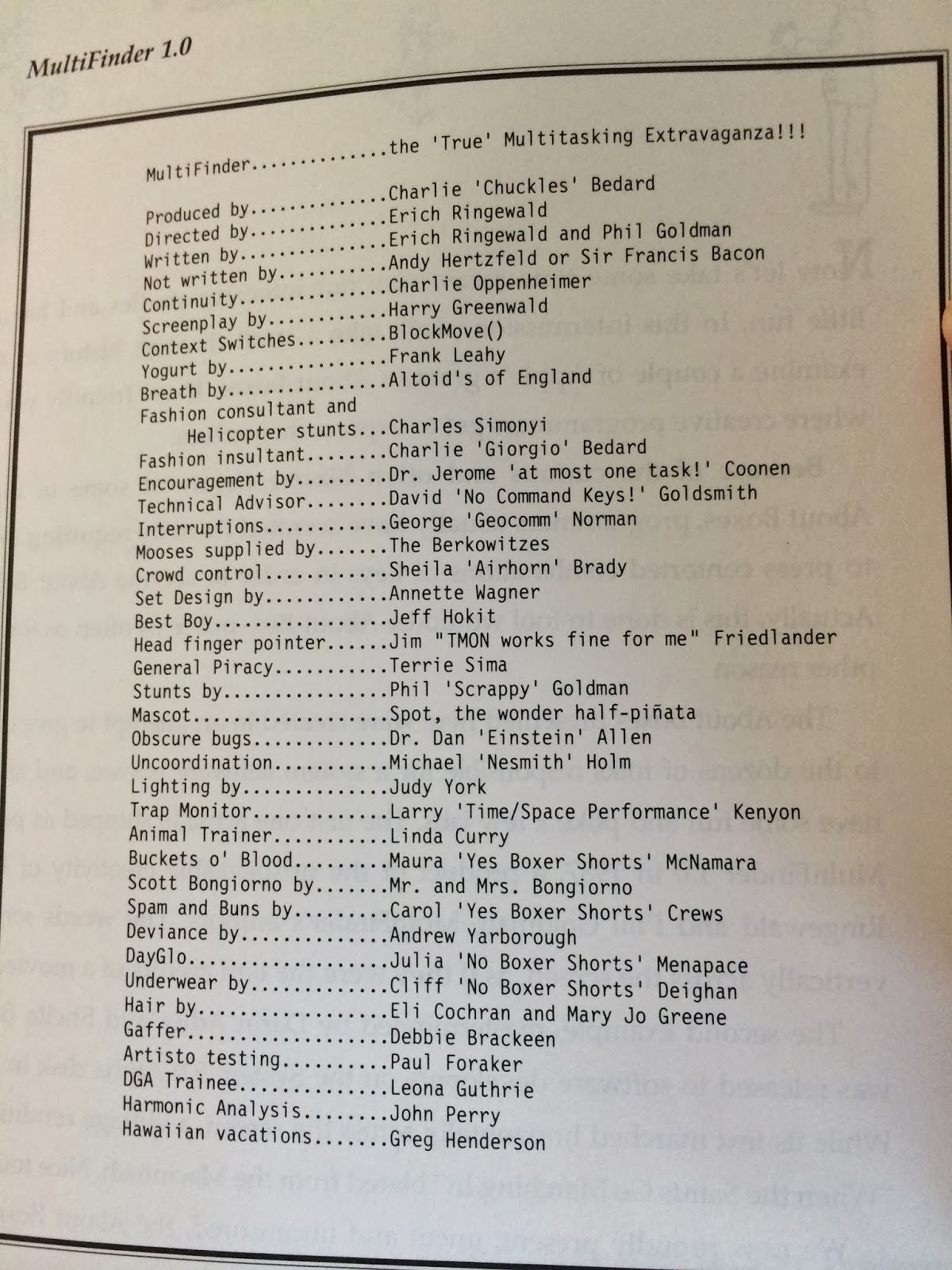
Click the images for big-enough-to-read versions
I was Apple's Developer Support Manager when this About Box shipped, and I got an email complaining about it. Specifically, the writer didn't like that the About Box included a reference to Jim "The" Lord (Jim Lord was a real person on the team) and also objected to the line Thanks to Satan for C Language brace style. You can't please everyone.

The folks who made the Macintosh SE managed to hide photos of themselves in ROM.


Soon the Secret About Box (which is a particular form of Easter egg) was well-established. The Secret About Box technique was useful for 2 reasons:

1. It lent an air of mystery to About Boxes because you had to know how to invoke them.
2. Teams could semi-plausibly hide About Boxes from management because they weren't obviously visible.

One of the best-known Secret About Boxes shipped with System 7.5.3. After following the secret instructions, which involved typing the phrase Secret About Box and dropping it in a certain place, you got a cool picture of a fake flag waving over Apple's real campus.


Windows XP had a credits screen that was Internet-based. (I forget exactly how it worked and can't Bing the answer. Maybe one of my old Microsoft pals remembers?) Because many Windows customers, especially governments, don't like hidden surprises in their software, Microsoft fully disclosed how to find this About Box and what it contained. Not much adventure in that approach.

Some software, like Hypercard 2.0 and BBEdit, puts the user's own name into their About Boxes. That's very nice of them.

About Boxes and the inside of a computer case are not the only places to sign your work. Sometimes companies publish books about how awesome they are, like Apple and Microsoft have done. In those books they sometimes like to do crazy things like list every employee they ever had, in teeny tiny type (much enlarged here):
From Inside Out: Microsoft In Our Own Words
From So Far: The First 10 Years of a Vision (Apple)
This is how a guy who mainly wrote documentation and helped developers got some fun credit. And yes, this is reminiscent of Apple listing employee names on posters for the Mac's 30th anniversary.

There are zillions of examples of great About Boxes. If you have any favorites, please bring them up in the comments.

Tuesday, January 28, 2014

Apple put up posters with the name of every employee ever

If you were online in tech circles last week, you couldn't miss the fact that last Friday was the 30th anniversary of the Mac. News sites and bloggers posted zillions of stories about the anniversary, and there was a big event at Flint Center, the site of the original announcement.

More surprising was that Apple itself celebrated the birthday. Apple is not noted for looking back. But this time, there was an extensive public website. And on campus, Apple had a party for employees, complete with t-shirts for all.

But it wasn't just a party. Apple created a set of 10 large posters containing the names of every employee who has ever worked for the company. On really really tall posters. With really really tiny names - something like 16,000 names per poster. The posters look like this:

Click this image to make it bigger (but not nearly actual size)

The text under the 30 reads:

A promise to everyone, kept by every one of us. On January 24, 1984, we made a promise to take the power of technology from the few and put it in the hands of many. This series of ten posters recognizes all those who have helped turn that promise into reality. In other words, every single person who has ever worked at Apple.

The names are in order of employee number. Combining that with the tiny type and the gray-on-white text, it's really hard to find a particular name. But Apple employees are smart and have come up with some clever hacks to narrow down where to look.

The first poster is the most interesting to me because it covers the time I worked there. Actually, because it contains 16,000 names, it probably covers the first 15 years or so of Apple. There are 10 posters total, which suggests how fast Apple has grown since then.

The posters are not in a public place, which means you can't see them unless you know someone who works there and you pay them a visit. I did that and spent some time staring at poster #1. After a while I found my name.


There you go.

Thursday, January 23, 2014

How the “lost” Mac intro video was found (and got my name stuck to it)

In 2004 Andy Hertzfeld was building Folklore.org, his amazing now-famous website devoted to first-person stories of the earliest days of the Mac. Andy was writing one of the key stories of the saga, the one about the day of the Mac's public unveiling. I mentioned to Andy that I had a video of the intro, and he was welcome to watch it to spur his memory of the great day. So Andy came over, we watched the video, he took notes, and wrote his story. In the comments Andy was kind enough to thank me for showing him the video.


Andy's telling of one of the most important moments in computing history was riveting. Right away, people were interested in seeing the video. I recorded the video over the air in 1984 from a public TV station that rebroadcast the event. Then it sat on a shelf for awhile - OK, for 20 years - until it apparently became something rare.

When people asked to get the video online, I explained the problem in the comments:


After a few days I did actually hear from someone who wanted to digitize the ancient video. He was a video producer in Germany who went by the name majo. This guy had a website with a bunch of Mac stuff and other things. majo promised to digitize the video and post it for anyone to watch and copy (this was before YouTube). For some reason, despite the fact that I had never met him and he was 5000 miles away, I decided to trust him. I put the precious videotape in a mailer and shipped it off to majo in Germany.

majo struggled with the terrible quality of the video. Not only was it 20 years old, it was a low-quality home format, and the original show had not been properly lit for video recording. Still, he did a fine job and extracted the most important segment: Steve Jobs revealing the Mac.

On January 24, 2005, Majo posted the video on his site for the Mac's 21st birthday. The traffic was overwhelming. To watch, you had to download the 20MB file, and majo's site soon crashed. We were SlashDotted, kottke.orged, and etc. He begged for mirror sites, and a bunch of other people helped out. I wrote a blog post about the video. I watched the comments come in from around the world as people woke up and discovered the "lost" video (that I didn't realize had been lost). The comments show how excited people were to discover the video, and how eager they were to help by mirroring it. It was a pretty cool day.

By the end of the day I finally had time to watch majo's edit of the video. To my surprise, he had added my name near the end with this generous but hilariously pompous credit:


A more accurate credit would have been "Recorded in January 1984 and kept on a shelf in the family room by Scott Knaster". But this was OK too.

***

Three weeks later, as if on cue, YouTube was founded.

Soon copies of the video started making their way to YouTube. Most of them included the part with my name. After awhile there were hundreds of different copies on YouTube. Some of them have millions of views. Why are there so many copies? I don't know. Because YouTube, I guess. I gained an odd sort of fame. Many people assumed I was operating the camera that filmed the event. (I was there as an Apple employee, but in the audience.)

In the months following, majo extracted and digitized other clips from the Mac intro. I assume those have made their way to YouTube also. The full video is available, and you can watch if you have 1.5 hours.

As the Mac's 30th anniversary approached, I started to wonder whatever happened to majo, and whether he had digitized any more clips. I went to his old site, but it seemed long-dormant. After some further digging I found sad news: majo died in 2010. I never did meet him, but he's the one who really got this video out into the world. All I did was neglect to get rid of an old videotape.

Thanks, majo. And happy 30th birthday, Macintosh!


Tuesday, January 14, 2014

Before the Mac was the Lisa, Apple's first graphical user interface computer

This is probably familiar to you.


Yeah, everybody knows that. But did you know that just one year earlier, on January 19th, 1983, Apple introduced the Lisa? You might know that Lisa was Apple's first computer with a graphical user interface. It was pretty cool but cost $10,000 and was a little ahead of its time.


Steve Jobs code-named Lisa for his daughter, but nobody acknowledged that at the time. Instead, Apple told people it was an acronym for "Local Integrated System Architecture". Folks who know better decided it really meant "Let's invent some acronym".

My first-ever job at Apple was Lisa telephone tech support. It was a great job: there were so few customers, and the applications were so easy to use, that I soon learned pretty much everything there was to know about the software and had spare time to learn about how you programmed it. I could even take the computer apart and put it back together (no tools!). The highlight of this job was the day Herbie Hancock called for support. Wow!

When I worked on the Lisa hotline, I got this cool lapel pin (shown larger than life):


For awhile I worked the 3 am to 10 am shift. I was 23 years old and this sounded great! My plan was to get up at 2, go to work, then go home and stay up until I got tired, then go to sleep. After 3 days of this I was running a major sleep deficit. On the 4th day, I went home and fell asleep about noon. A few hours later, a 6.5 magnitude earthquake woke me up. Panicked, I jumped out of bed and twisted my ankle, thus becoming an earthquake casualty. My sleep was wrecked for the rest of the week and I soon gave up the graveyard shift.

Everything about the Lisa was new and different: bitmapped display, mouse, and graphical applications. These pictures are from Lisa data sheets of a few of the applications:


LisaCalc was a spreadsheet (data sheet from the collection of my garage)


Lots more detail about how LisaCalc worked


LisaCalc specs. Note the first feature: "Basic learning time, less than 30 minutes"


LisaGraph was pretty cool for visualizing your data (although nobody used that term then)


LisaWrite was my favorite. It went a long way toward WYSIWYG.


Even the floppy disks (the what?) were unusual. They were Apple's proprietary Twiggy disks, with 800K capacity:


Those were the days.


Tuesday, January 7, 2014

Demoing new products at a rave is more fun than it sounds

In the 1990s I worked at General Magic, an extremely ambitious startup that began as a project inside Apple and then became its own company. The people at General Magic wanted to make portable touch-screen personal communicators that could send and receive beautiful notes called telecards, provide access to online shopping, and make phone calls. It was sort of like trying to make an iPhone in 1993.
My badge from Digital Be-In 7
After a few years of work it was time to show off our prototype software (called Magic Cap) and hardware. We had a super funky venue: the Digital Be-In, a psychedelic San Francisco tradition that was a cross between a rave and a trade show. We set up our booth next to a few others, right beside the massive light show and huge stage, and the party started.

People were surprisingly cool about seeing neat tech that bumped up against the dance floor. The drugs probably helped. Small devices were pretty novel back then. One of our best tricks involved faxing, a very old technology with a new twist. We asked people for their fax numbers, then had them send a fax to themselves from our small devices. This wasn't wireless yet - each device was connected to a landline - but it was still cool and helped people feel connected to what was possible. Of course, we could also send email, but not everybody had an email address, especially in this crowd. We also showed an early version of a map program. We asked people their addresses, then called up a map and asked "Is this your neighborhood?" like a card trick. They loved it. I got to demo that one for Timothy Leary, which was one of the highlights of the night for me.

Then after a few hours of this, a funny thing happened: the power in the venue went out. The music and lights stopped, and most of the other booths were dead. But we had battery-operated devices. So we could still give demos, plus show how great it was to not depend on AC power. Of course, it wasn't that great - our displays had no backlights, so you could barely see the screen. Oh well.

Eventually the power came back on and the music resumed. Finally the party ended. I suddenly realized I had been showing off our stuff for 7 hours without a break. There was so much in the software, and it had mostly been a secret for so long, that I was thrilled to share it with people.

That was fun.

Tuesday, November 5, 2013

Microsoft steals bread meant for the homeless, and other food tales of the road

When Microsoft shipped Office 98, the Redmond marketing team set up a roadshow to demo the new software at Apple offices (yes, Apple offices) around the country. I was pretty good at giving demos, so somehow I wound up getting asked to give the Office 98 demo on this tour. This was a 50-minute demo, part of a half-day program. The plan was for morning and afternoon demos in 5 cities in 5 days, which sounded pretty fun to me.

The tour schedule looked like this: Monday in Dallas, Tuesday in Atlanta, Wednesday in D.C., Thursday in New York, and Friday in Boston. There were only four of us on the tour. We would start the first demo at 9 am, finish up by 1 pm, take an hour for lunch, do another show in the afternoon with a new audience, then pack up and race to the airport to fly to the next city.


The pace was pretty intense for that week. There wasn't any time to go out for lunch, so we had to rely on whatever was brought in to the Apple offices, which varied widely. Dinner was worse: we never had time for it, because we had to rush to the airport. If we were lucky, there were still places to get something to eat at the airport. Otherwise it was vending machines and leftovers.

On Tuesday, we stayed a Doubletree Hotel in Atlanta. We got there around midnight and had Doubletree chocolate chip cookies for dinner. That was pretty good!

By Wednesday in Washington I figured out that we were never getting a decent dinner. Plus, the Apple office that day provided tasty sub sandwiches at lunch. Clever guy that I was, I stuffed an extra sandwich in my bag for dinner. I was set. When we got to the airport, late as usual, I looked in my bag to find the delicious sandwich had leaked Italian dressing on everything. That bag smelled like a deli for years afterward.

That night we flew to New York, my first time there. For some reason, Microsoft's travel department had booked us at the Waldorf-Astoria. I figured I'd never be back there again on my own dime, which so far has been true. Although we checked in very late, room service was still available. Since it was my first trip to New York, I ordered a New York steak and New York cheesecake. I probably thought that was really clever. Since I wasn't paying, I also took a $29 jar of peanuts in a Waldorf-Astoria logo jar. I still have the jar.

On Thursday, traffic and weather conspired to get us to JFK airport very late. No shops or food counters were open in our remote terminal, including a Panera bread cart that had just closed. We hadn't eaten all day and begged to buy some bread, but the Panera dude said no. I watched as he put all the leftover bread into a large plastic bag. "Can we buy that bread?" I asked. No, he said. It was going to the homeless shelter. 

He finished bagging the bread, put the bag on the cart, and left. The four of us debated what to do. We were hungry, and all the shops were closed. Once we were sure the guy was out of sight, we carefully opened the bag and grabbed eight rolls and four pastries. We closed the bag up again and left a $20 bill tucked under it. As we ate the meager dinner, I wondered what it would be like to get fired for embarrassing Microsoft by stealing bread from homeless people.

On the last leg of the trip, we arrived in Boston after midnight and got to the hotel at about 1 am. When I checked in, the desk clerk produced a box that had been shipped to me. This was the first night of Passover, and my amazing wife had packed and sent a box of Passover food goodies for me to enjoy. Needless to say, that was the best meal of the whole trip.

And on Saturday we went home.

Tuesday, October 29, 2013

Inside the first issue of Macworld

Having a whole new magazine devoted to the Mac was pretty cool back in 1984. You've seen the cover of the first issue, right?

The first issue of Macworld appeared on the same day as the Mac's introduction, which meant a few interesting points:
  • Lots of things were very new that day and worthy of coverage, including the Mac itself and all its software, graphical user interfaces, and even the mouse.
  • Although there was plenty of Apple news to cover, there wasn't much from third parties. The most prominent support came from Microsoft, as you can see in this ad.
  • To get this issue out at the same time as the Mac, Apple obviously cooperated with the publisher and gave them plenty of access while the Mac was still secret. Needless to say, that doesn't happen anymore.
So what's inside? Here's the table of contents:


It's a pretty good assortment of articles about using the Mac, a nice set of brief interviews with team members, a long conversation with Bill Gates, and lots of great images that showed off the Mac's graphical powers. There are even a couple of pieces about programming. Here's a sample of some of the articles:
Remember, everything was new, so people had to be shown around the desktop.


Who remembers Desk Accessories? (Kids, ask your parents.)

Possibly the most soulful photo of Bill Gates ever (shot by the great Ed Kashi).
This article introduced users to the mouse and taught them good mouse hygiene (picture at lower right).


Here's an ad for Dave Winer's ThinkTank, which came out early in the Mac's life.

Examples of illustrations created with MacPaint, comparing screen vs. printer pixels.
Susan Kare's famous illustration.

These products are not pictured because they didn't exist. How many of them ever shipped I can't say. Apple Fritter Modem???

Maybe the most amazing fact of all is that Macworld is still alive and well after nearly 30 years.

UPDATE 9/10/14: Or not. :(

Tuesday, October 22, 2013

How Microsoft got back to making great Mac software

I've blogged previously about working in the Mac group at Microsoft and how much fun that wasn't during Macworld Expo. In those strange days, Microsoft was doing tremendous work supporting the Mac, which resulted in really nice apps. These apps happened for 3 basic reasons:

First, Microsoft created Word 6 as a cross-platform product designed to look and feel the same on Windows and Mac. This was exactly what Mac users didn't want. And because it was tuned for Windows, the Mac version was impossibly slow and ponderous. While Windows users loved Word 6, Mac users absolutely loathed it, and people in Redmond noticed. This caused them to *ahem* Think Different about how they should create Mac software.

Second, the Internet happened. This created a brand new, very important kind of app, and Microsoft could use it to experiment with new ways to develop Mac software while also thinking about fixing the Word 6 problem.

Third, Microsoft got hold of not one, but an entire group of really good Mac developers and product folks. This team (Don Bradford, Shayne Bradley, Bowen Simmons, Terry Worley, Steven Lovett, and others) had recently left Apple and were now ensconced in a tiny office in Santa Clara as a remote Silicon Valley outpost of Microsoft, trying to do some good at the Evil Empire. The group called their office MS-Bay. They even had their own logo stuff like t-shirts and keychains, created by artist Sonya Paz, who doubled as our office manager.


Thanks for not hanging up on me

I joined the team in 1995 after a recruiter called me and said she was looking for Mac folks to work at Microsoft. I told her I was interested, and she thanked me for not hanging up on her, which she said most people did in response to that offer. On my first day on the job I got an email summoning me to Redmond for orientation. I mentioned that to Sonya, who casually said "Oh, don't worry, we'll take care of that for you". I soon learned that our office was succeeding at staying Mac-focused by keeping as far away from Redmond as possible.

This group created Internet Explorer for Mac, and they had free reign to make it (to use the vernacular of the time) Mac-like. Of course, there was a Windows version of IE, and the Mac one had to be similar in some respects, plus support some Microsoft technologies. But it was a native Mac app, supporting most every Mac OS technology Apple had at the time. This really helped when comparing it to Netscape, which was unashamedly cross-platform and apparently not Mac native.

The Bill Gates crisis

One particular crisis occurred when an edict came down from Bill Gates himself. The new version of IE for Windows included an animated Windows logo in the upper-right corner (remember when browsers had those?). We were told the Mac version had to have the same thing. A Windows logo. In a Mac browser. I think we actually shipped a version like that before convincing those who needed convincing what an Insanely Bad Idea it was, and we changed it a more sensible animated letter E.

The team worked hard to make Internet Explorer into really great Mac software, and eventually in those pre-Safari days it became the default browser on the Mac as part of the historic Apple - Microsoft deal of 1997. MS-Bay continued for awhile more until it merged with the Mac Office team in Redmond that was creating Office 98. Little did anyone know that before too much longer, office software would become a lot less important.


Tuesday, October 8, 2013

MAC: The Macintosh Calendar 1985 (complete)

Last week I posted about MAC: The Macintosh Calendar 1985 and included a couple of images from the calendar. Lots of folks asked to see more, so today I photographed the entire calendar and posted it. I apologize in advance to anyone depicted in this calendar who would rather not see these images again. It's all done in the name of history.

As I said last week, can you imagine Apple allowing this sort of thing to happen now? No, you cannot.

Click this image to see the whole calendar


Monday, October 7, 2013

The truth and falsehoods of Jobs (the movie)

My buddy John Vink saw Jobs and wondered just how accurate it was. But unlike most of us, John (a) knows several of the folks depicted in the movie and (b) has a TV show. So he sat down with Steve Wozniak, Daniel Kottke, and Andy Hertzfeld and went through the movie scene by scene to discuss what really happened and how they felt about it. It's a very cool piece of video.

Tuesday, October 1, 2013

When the Macintosh had a pinup calendar

If you think Apple has its fanatic fans today, check this out: in 1985 when the Mac was one year old, Banbury Books produced a wall calendar showing pictures not of Mac products, but members of the Mac team at Apple. MAC: The Macintosh Calendar 1985 featured photographs by D.W. Mellor. As far as I know, a product like this for the Mac never happened again. Each month had a photo depicting one or more members of the Mac team. Under each picture was a peppy caption describing the scene.


Here's Mr. January, +Chris Espinosa:


The calendar's month pages included holidays, as most calendars do, but also notations for important dates in Apple history. March 10 was "Design of the Apple I completed (1976)", December 15 was "First Apple shareholders meeting (1981)", and so on. The calendar also included birthdays of key Mac team members, in case you wanted to birthday-stalk any of these folks in the pre-Facebook era.

In addition to the big month pages, each month had a small day-sized photo of some component or accessory, such as a 3.5 inch floppy, a bunch of Macs being tested at the factory, and even an Apple-logoed delivery van.

The calendar-makers were inclusive in choosing their subjects. They depicted not only Apple's Mac celebrities of the day, but also people from the factory who were not well known. On the other hand, some folks who certainly deserved a whole page can only be found in group shots, and others are missing entirely.


I worked in Developer Technical Support, which was officially part of the marketing team, so I'm on the page for October with many other members of that team, including +Guy Kawasaki. I'm the only person on the page who's partially hidden by a Mac. This is the only time I have appeared in a pinup calendar so far.


Can you imagine Apple allowing this kind of thing to be published today? No, you cannot.

Tuesday, September 24, 2013

Steve Jobs demonstrates a superpower at a party

In 1997, Apple was beleaguered and struggling. But Steve Jobs was back, and there was hope that things might change. Part of that hope came from arch-rival Microsoft, which had shockingly invested in Apple and was working on a sparkling new version of Microsoft Office that would give the Mac an instant shot of renewed credibility. I was working on the team that built Internet Explorer for Mac, which was closely related to the Mac Office team, and I knew that our new Mac software was pretty cool.


Microsoft called the new version Office 97, because there was already a Windows version by that name. But then Steve Jobs convinced Microsoft to change the Mac version name to Office 98 so it could be shinier and newer than what Windows had.

Microsoft rolled out Office 98 at Macworld Expo in January 1998. To celebrate, we held a massive party at the San Francisco Gift Center. The place was overflowing with people. Food and drinks were being served. There was loud music. And up on a balcony that overhung the party, people from Microsoft were trying to talk to the crowd about Office 98. Nobody was listening. The music stopped, but people kept partying, because it was a party. The speakers tried desperately to get everyone to quiet down and listen to them, but it wasn't working.

And then, suddenly, Steve Jobs arrived at the party with a small entourage. Steve walked out on the balcony to join the Microsoft folks who were running the show. Party-goers seemed to notice Steve's arrival, but it was a small distraction at best. The noise continued. Then something remarkable happened. Steve faced the crowd and held up his index fingers to his mouth. He said "shh". Turning his head side to side to reach the whole crowd, he said "shh" again. That was it. The room fell silent. Steve Jobs had turned off a party.

Steve spoke for a few minutes about how awesome Office 98 was and how it could only be done on the Mac. And then he was gone, and the party started up again.


Thursday, September 19, 2013

MacHack was the strangest and best conference ever

Once upon a time, every year from 1986 to 2004, there was an amazing annual programming conference called MacHack.

Some of the key features of MacHack were:
  • It took place at a crappy Holiday Inn in Dearborn, Michigan. There was little to do but hack.
  • The conference started at midnight with a keynote, and the keynote always lasted several hours. I was part of one that ended at 6:50 AM.
  • Every attendee, technical or not, was encouraged to create a hack. All hacks were presented at a hack show on the third night of the conference.
  • Hacks didn't have to involve technology. One recurring hack (executed by +Adam Engst) was to hide a wooden stake in the hotel so well that it would still be in the same place the following year.
  • Hacks were supposed to be cool but impractical. When someone presented a practical hack, the audience derisively shouted "Useful!" .
Conference program from guess which year
One of my favorite MacHack moments took place in 2003. I was in the conference lounge around 3:00 am, eating dinner and trading instant messages with +Chris Page. Chris was at home in Silicon Valley, and I was giving him a hard time because he didn't come to the conference. I went to sleep for a few hours (even though MacHack's motto was "Sleep is for the weak and sickly").

I woke up around 8:00 am and headed to the lounge for breakfast. As I sat eating my sugary cereal, I glanced to my left and was astonished to see Chris Page himself ambling into the room. Somehow he had traveled 2300 miles in a few hours in the middle of the night. I tried to say something, but all I could do was laugh. Chris smiled and started laughing too. He had just pulled it off: he hacked MacHack.


If you want to know more about MacHack, you can read this article I wrote about the 2004 conference.

Thursday, September 5, 2013

The first Apple II ad

A couple of weeks ago I mentioned the classic issue of Scientific American on "microelectronics" that included the first ad for the Apple II. Because I never throw anything (interesting) away, I found my copy of that four-page color brochure at home. Here's the cover:

Brochure courtesy of ComputerLand of Denver (defunct)


36 years later, Apple still worries a lot about simplicity. That's pretty cool. The inside looks like this:

A completely typical Apple II setup.

The copy is kind of crude compared to today's Apple, but you can see the germ of the Apple style being developed. Most of it is pretty geeky by modern standards, but this was absolutely mainstream next to pretty much every other hobby computer being sold at the time. I mean, come on! Those are actual real normal non-nerds discussing game controllers over a cup of tea and a sliced apple on tasteful dinnerware. Throughout all the ad copy, only one application is mentioned and depicted: STARTREK. The rest is all about things like writing your own programs in BASIC, using a cassette recorder for storage, and all the great peripherals that will be coming out.

Finally, here's the back of the brochure:

Moore's law at work.
Posting detailed specs on the back was pretty standard for the time. The Apple II included a 280x192 high resolution graphics mode, a 1 MHz CPU (that's megahertz with an "M"), a maximum of 48K RAM (but who could afford that?), and a pretty nifty ROM filled with +Steve Wozniak magic that included a monitor (command shell), Integer BASIC, the SWEET 16 virtual machine, a mini-assembler that was the first assembler I ever used, and more goodies.

The Apple II was an amazing machine, and this brochure was my first hint that something special was going on. But I almost didn't buy one because it was too expensive. Almost didn't, glad I did.

Wednesday, September 4, 2013

Working for Microsoft at Macworld Expo was no picnic

Believe it or not, there was a time when Microsoft dominated and everybody else hated them (only half of which is true now). The Internet in its role as Great Disruptor helped turn that all around, starting in the late 1990s. As Netscape, Apple, and other companies were using the Internet to move forward, Microsoft was working on how it could own the Internet like it owned personal computing.

In the middle of all that, I ended up working on Mac stuff at Microsoft with a ragtag band of Apple refugees deep in the heart of Silicon Valley. These folks built Internet Explorer for Macintosh. It was hand-crafted for Mac OS, by experienced Mac developers, and supported virtually every important native Mac technology, unlike Netscape, which looked and worked a lot like its Windows version and was (I assume) the product of a cross-platform development strategy. Oh, the irony.

What amazing packaging we had back then.
N.B. "Designed for
the Mac".
(Photo courtesy of +Louis Gray)
My job was to write docs and do technical evangelism. In 1996, the Macworld Expo keynote consisted of Apple über-Evangelist +Guy Kawasaki showcasing some great Mac apps. Guy loved Internet Explorer because it was a wonderful Mac app, which really twisted his brain in knots, but he gave us a slot in the keynote. So I got to do a five-minute demo of Mac IE in front of thousands of Mac fans. Although I tried to be ingratiating and self-deprecating, and I worked hard to establish that I was a Mac nerd just like them, nobody was buying what I was selling. After Guy introduced me and the boos died down, I did my little demo, then finished up with the pièce de résistance: a t-shirt with the IE logo and the words

Internet Explorer for Macintosh
Guy says it's OK to try it

Guy laughed. Nobody else did. The keynote moved along.

Although I'd been to almost every Macworld Expo, I never really noticed the Microsoft presence before. Now I was about to find out what that was like (spoiler alert: it's not awesome). Our booth was essentially empty all the time. People used it as a shortcut to avoid the busy aisles around the jam-packed Apple and Adobe booths. As they walked through they sometimes muttered darkly about Microsoft, or chuckled at how empty the booth was. One guy who actually stopped in the booth looked at the stack of IE CDs (yes, as depicted above, companies really used to give out software on CD, even web browsers; downloads at 56K took a long time) and started picking up a few copies. I walked over and said he must have tried and liked IE, because he was taking copies for his friends. He grinned and replied no, he would never use our goddamn software, but he liked to put the CDs in his microwave and watch them crackle. I just nodded and backed away.

On the last day of the expo, I did an interview with KCBS radio in San Francisco. They asked the important question: what in the world was Microsoft doing at Macworld? As I explained that we were a Mac-loving bunch who had created and were giving away a really good web browser for free,  I heard laughter behind me and the reporter cryptically said that the Apple – Microsoft "rivalry" appeared to still be going strong. It turns out that during the interview, people behind me were making all sorts of fun gestures including rabbit ears, throat-slits, and middle fingers. 

Those were the days. 

Tuesday, August 27, 2013

When your workplace is also a tourist attraction

Disney World used to have an onsite animation studio. Animators worked in the studio on real movies while tourists stared down at them through giant glass windows. I thought that was kind of weird.

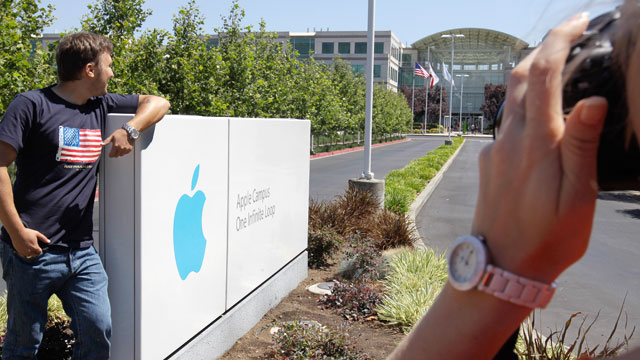
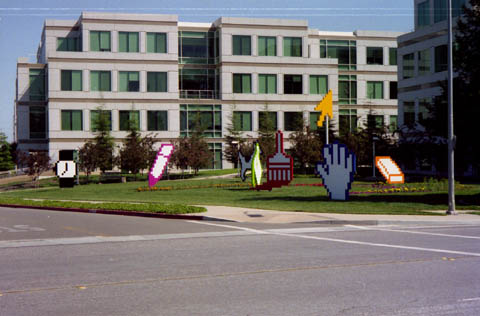
People like factory tours, especially for products they use and love. Even when there's no tour, people still want to drop by. The Google campus in Mountain View is always buzzing with people who want to come see what's going on. There are no public tours, but so what? You can see these folks every day, taking pictures with Google signs, or posing with the Android dessert statues on the lawn of Building 44. They visit Apple, too. (No desserts there, and the icon garden is long gone.)


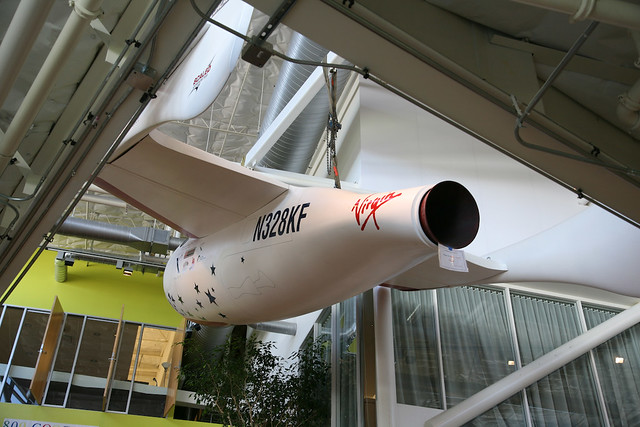
Google has an informal tour program. There are always groups of students, visiting dignitaries, and others coming through. There are even suggested itineraries and hotspots: the dinosaur skeleton, the SpaceShip One replica, the giant working Nexus phone, the bowling alley, the skeeball lanes, the anti-gravity ray prototypes. I've given a few of these tours myself, and it's always fun. People see the playful side of working at Google, without having to think about how the actual, less playful work gets done.

One day a couple of years ago, I was walking back to my office when I found three young men just sort of hanging around an empty lobby. They were futilely trying to look like they belonged there. I asked them if I could help (the classic euphemism for "Who are you and what the hell do you want?"). With wide eyes, they admitted they had no business there, that they were computer science students from Italy who were fans of Google and just wanted to look around. So instead of asking them to leave or calling security, I decided to show them around. We spent half an hour visiting the aforementioned attractions, finishing up at the Google Store (always exit through the gift shop). They were incredibly happy and grateful, and I was really glad I took the time. They hadn't come to steal the silverware after all.

My wife and I have often said, only half-joking, that in the future we should run a Silicon Valley tour company. We would take people to Google, Apple, Intel, the Computer History Museum, historical sites like Xerox PARC and the birthplace of the hard disk, and so on. I'm sure we could get plenty of business.

Thursday, August 22, 2013

This is my Steve Jobs story about interviewing at NeXT

With the release of the movie, I've been thinking a bit about Steve Jobs lately. I only have a few Steve Jobs stories. This is one of them. (Adapted from a Google+ post).

I bought an Apple ][ in 1978, loved it, and moved to California to work at Apple in 1983. After 4 amazing years there, I left to go to a startup, because that's what you did, even back then. I loved Apple, but I had learned a lot and gotten a bit bored, so leaving seemed like a pretty good idea.

The startup didn't work out for me, and after 6 months, I wanted out of there. Now I needed another job. I conducted a thorough and extensive search of every company ever founded by Steve Jobs. Pretty soon I had an interesting offer to return to Apple. But I also had an interview at NeXT. At the time NeXT was still in stealth mode. People knew they were making some kind of computer, but there were few details.

I was subjected to the typical Silicon Valley all-day interview. I thought I did well. Nobody told me anything about what they were building; it was a secret. Most of my interviewers knew me from Apple, and they focused mainly on selling me on NeXT. Can't you tell me something about the product, I asked? No. You have to take a leap of faith, they said.


My final interview was to be with Steve Jobs. I was told that in those days, Steve had to interview everyone who might be hired. I was nervous, but excited. I was a huge fan but had never really met Steve during my time at Apple.

The interview with Steve went fine, I thought. Sure enough, a few days later the hiring manager called to offer me a job. The next day, in the mail, I received an offer letter from NeXT. At the bottom was the place for me to sign. Under the signature line it read:

"I accept this insanely great offer!"

So now I had to decide whether to return to the comfort of Apple or head into the unknown at NeXT.

Well, I just couldn't make that leap of faith. Like most people at that time, I thought Steve's best work was already behind him. I decided to return to Apple instead. So I called NeXT and declined the offer. I was told that Steve would probably call me back. I said OK, and braced myself for his call, sure that I had made the right decision.

Minutes later, Steve called. His opening line to me: "I hear you don't want to work with the best people in the valley, on the coolest new technology, making an incredible new product. Is that true? Do I have that right?" Wow. What do you say to that? I stammered and laughed nervously a little. Finally I managed to say that I had decided to work at Apple, avoiding his direct question that was impossible to answer anyway.

We went back and forth a little. I didn't budge and eventually he stopped pushing. Finally, he asked if there was anyone else I could recommend. I gave the name of a friend (let's call him Earl) who was still working at Apple, relieved to be past the point when I had to say no to Steve Jobs.

And then, this happened

But I wasn't done yet. A few days later, my home phone rang at 10:30 PM, which was very unusual. The call went like this:

"Hello?"

"Is this Scott? Scott who works at Apple?" The last word was clearly said in a mocking tone.

"Uh, that's me." I thought I recognized the voice.

"Hi Scott. This is Steve Jobs. Can you help us find your friend Earl? We interviewed him and now he disappeared. We think Apple has locked him in a room or something."

Terrified of having to say no to Steve Jobs again, I gave him Earl's unlisted number. (I'm not sure I ever apologized to Earl for that.)

"Thanks. Oh, and, let us know when you get tired of Apple again."

"Uh, I will, Steve. Thanks."


Overall I'm very happy with my career so far. But I wish I had accepted that insanely great offer.