Showing posts with label silicon valley. Show all posts

Thursday, February 13, 2014

How you sign your work in Silicon Valley: About Boxes, Easter eggs, and computer cases

Sometimes in Silicon Valley we make stuff. Like any makers, or really anyone who wants a bit of fame and immortality, we like to sign our stuff. There are many ways to do this.

Even in ancient, pre-Mac times, software usually had credits buried in it somewhere. With the advent of graphical user interfaces in the mid-1980s, the About Box became the standard place for credits. The About Box was easily accessible to users and was always found in the same place. This box was in the original Finder and was one of the first About Boxes many Mac users ever saw:


Through the 1980s, most companies were OK with this practice. Apple was schizophrenic, keeping some teams from announcing themselves while encouraging others to sign their work. The original Mac team literally signed the case mold, ensuring their names would appear on the inside of every Mac produced.


As technology progressed, About Boxes got fancier. One version of MultiFinder for Mac got out the door with this epic About Box:

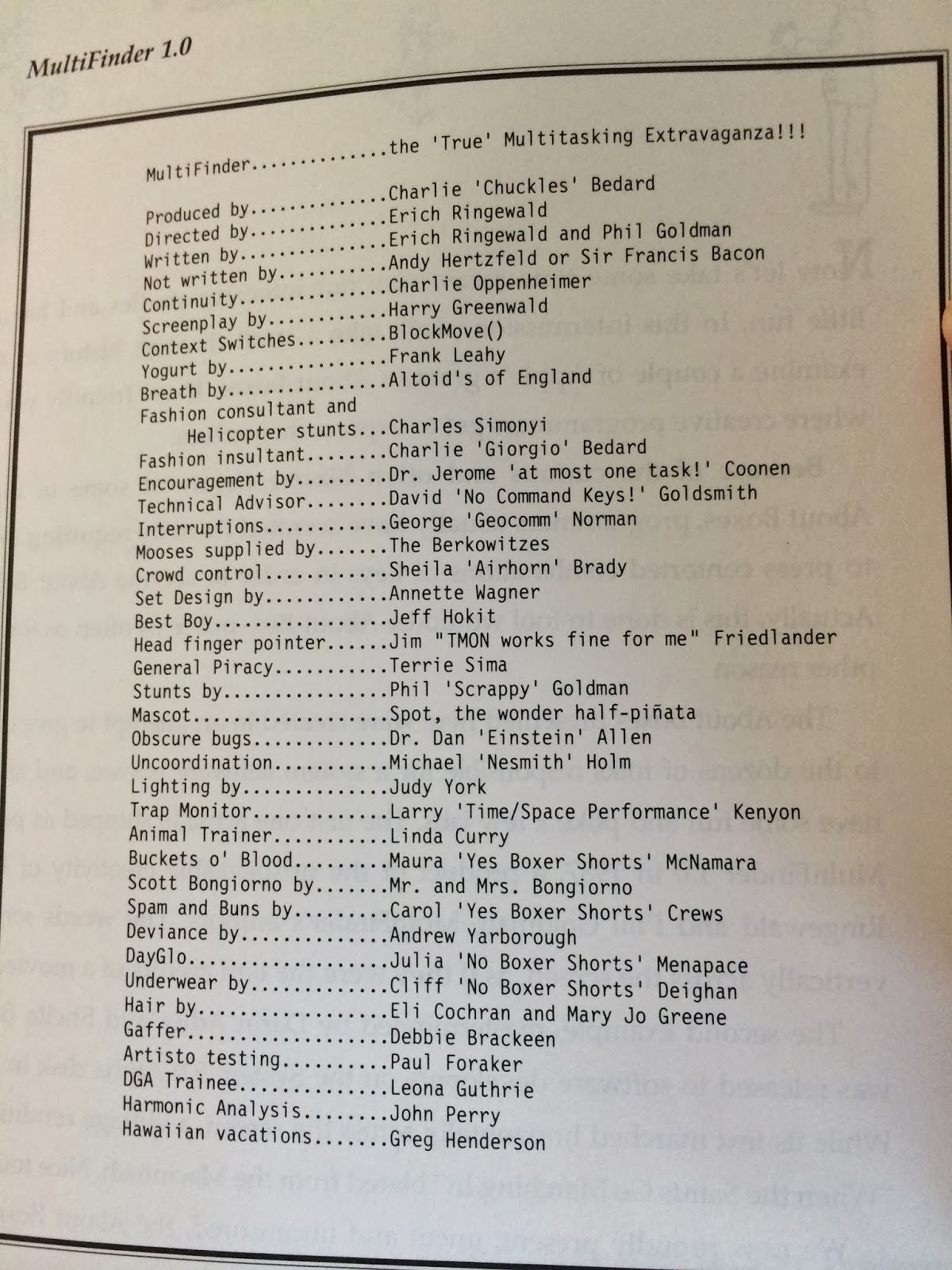
Click the images for big-enough-to-read versions
I was Apple's Developer Support Manager when this About Box shipped, and I got an email complaining about it. Specifically, the writer didn't like that the About Box included a reference to Jim "The" Lord (Jim Lord was a real person on the team) and also objected to the line Thanks to Satan for C Language brace style. You can't please everyone.

The folks who made the Macintosh SE managed to hide photos of themselves in ROM.


Soon the Secret About Box (which is a particular form of Easter egg) was well-established. The Secret About Box technique was useful for 2 reasons:

1. It lent an air of mystery to About Boxes because you had to know how to invoke them.
2. Teams could semi-plausibly hide About Boxes from management because they weren't obviously visible.

One of the best-known Secret About Boxes shipped with System 7.5.3. After following the secret instructions, which involved typing the phrase Secret About Box and dropping it in a certain place, you got a cool picture of a fake flag waving over Apple's real campus.


Windows XP had a credits screen that was Internet-based. (I forget exactly how it worked and can't Bing the answer. Maybe one of my old Microsoft pals remembers?) Because many Windows customers, especially governments, don't like hidden surprises in their software, Microsoft fully disclosed how to find this About Box and what it contained. Not much adventure in that approach.

Some software, like Hypercard 2.0 and BBEdit, puts the user's own name into their About Boxes. That's very nice of them.

About Boxes and the inside of a computer case are not the only places to sign your work. Sometimes companies publish books about how awesome they are, like Apple and Microsoft have done. In those books they sometimes like to do crazy things like list every employee they ever had, in teeny tiny type (much enlarged here):
From Inside Out: Microsoft In Our Own Words
From So Far: The First 10 Years of a Vision (Apple)
This is how a guy who mainly wrote documentation and helped developers got some fun credit. And yes, this is reminiscent of Apple listing employee names on posters for the Mac's 30th anniversary.

There are zillions of examples of great About Boxes. If you have any favorites, please bring them up in the comments.

Tuesday, December 10, 2013

Walking into a tree, mutilating a muffin, and other Danger fun

In 2003 I left the comfort of Microsoft's employ and struck out into the cold Silicon Valley recession looking for work. I soon connected with Andy Rubin, my co-worker from General Magic days, and got a job at his new company, Danger Inc. Danger created the Hiptop, a revolutionary mobile device for phone and other kinds of communications. You could use the Hiptop for email, AIM (AOL Instant Messenger, kids), web browsing, SMS, and other apps. The Hiptop had lots of great features, but the real jawdropper was the way you could flick the screen up with your thumb to reveal a keyboard underneath, as animated in this really cool holographic postcard.


The Hiptop was a developer platform, and Danger hired me to write developer docs. Danger was an awesome and weird company, filled with brilliant fun people. The offices were a strange complex on University Avenue in Palo Alto. Supposedly, the the place used to be dental office, and there were odd things around, like sliding doors and ambient noise devices. Every so often you would hear a pssst sound like escaping air, but nobody knew where it came from. The building was so close to the Caltrain station that when it was time to go home I could wait at my desk until I heard the train arriving, then grab my stuff and get to the station in time to board. The adopted company restaurant was Darbar, which was both loved and hated. Well, it was both enjoyed and ridiculed.

The Hiptop (in product form as the TMobile Sidekick) was my first indication that people would soon be getting lost in their phones. One day I was walking around downtown Palo Alto while AIMing with a friend when, yes, I walked into a tree. From then on I tried to avoid AIMing while walking (or driving).

I was only at Danger for a few months. In that time I faced just one deadline crunch. I was working in the early evening feeling the pressure and I was frustrated about something. I got up from my desk and wandered to the kitchen. There was a big pink bakery box with the bare remnants of that morning's breakfast pastries. With malice I grabbed a white plastic knife and proceeded to viciously attack a defenseless muffin. In seconds I had hacked it to bits. This all happened while one of my co-workers watched. After a few seconds of stunned silence, he said simply "Knaster has gone off the edge". And I had. But I got better.

Thursday, August 15, 2013

Witness to history

"I don’t believe in magic, but I believe in weird shit. I’ve had a weird shit life."
  – Rose Walker, The Sandman, by Neil Gaiman

I've been lucky enough to be around lots of cool tech things that happened over the past 30 years. I had a minor role in some of them. Others, I just witnessed as they sprang forth into life. Along the way, I've lived through a few good stories, like the time Apple security asked if I had snuck the just-fired Steve Jobs into the building, or the time I watched a co-worker nearly plunge off the top of a 10-story building during an unusual "company meeting".

I fell in love with cool tech at an early age. I watched 2001 and I wanted to use a HAL 9000 (except for the whole SPOILER ALERT murder part). I saw The Andromeda Strain and I wanted to work at a top secret underground lab like Wildfire. When I was 12 I got access to a computer you could call on the phone and program to say synthesized words. I made it sing "Daisy".

When I was 17 and still in high school, I read an issue of Scientific American that cemented my addiction in two ways: it was all about the future of computing, and it included a 4-page full-color ad for a very unusual computer called an Apple ][. The first page was just this:


And that was that. Less than 3 years later, after starting my important college years and then quickly quitting because there were no personal computers there, I got a job at Apple. And that's when the stories really started.

Tuesday, August 13, 2013

Decades and decades and decades

A few months ago I celebrated 30 years of living and working in Silicon Valley. I know that makes me seem impossibly old to many of you, but I assure you it's not only possible I'm that old, it's true.

I moved here in 1983 specifically to work for Apple Computer Inc., a company I fell in love with because I was a huge fan of their products. When I flew to SJC to interview at Apple, I rented a silver Nissan Sentra and headed out to find my dream. I cruised Highway 280 and approached Cupertino excitedly, waiting for what I knew would be a 60-foot neon sign looming over the freeway indicating Apple headquarters. I was shocked when instead of such a monument, I actually arrived on sleepy Bandley Drive to find a series of one-story tilt-up buildings with modest wooden signs out front.

Update: what the Apple wooden signs looked like


Me, Chris Espinosa, and two cardboard cutouts (ca. 1986)
It didn't matter. The buildings could have been made of cardboard for all I cared. I imagined the magic that went on inside. I was at my favorite company, in the tech center of the universe. When I went to eat lunch at a nearby sandwich shop and heard people at one table talking about CPUs, while another group chatted about Pascal programming, I knew I had just moved to nerd heaven. THESE WERE MY PEOPLE.

I lived in Apple House, near the campus in Cupertino. But that's another story.

And now, 30 years and several jobs later, I'm working at Google, and here's the amazing thing: I still love Silicon Valley and technology. I still love coming to work every day - almost - and getting to play with the future. I wouldn't trade it for any other job or any other place. And I know how incredibly lucky I am.

So here's to another 30 years. By then maybe +Ray Kurzweil will have figured out a way to keep us all going for much much longer.